
FRITSCH GmbH, a specialized manufacturer of laboratory application instruments, provides solutions for rapid industrial applications in process monitoring and quality assurance, as well as accurate and reliable research applications for industrial and academic laboratories.
Established in 1920 as an independent family-owned company, FRITSCH's headquarters are located in Idar-Oberstein, Germany, with subsidiaries in France, Russia, Singapore, China, and the United States.
FRITSCH's core competency lies in the innovative research, development, and production of superior sample preparation instruments and particle size analyzers developed using laser diffraction principles. With global business operations, FRITSCH is adept at identifying effective solutions for challenging tasks across various industries. All instruments developed by FRITSCH combine excellent reliability, innovative technology, and simple operation.
FRITSCH is committed to uncompromising quality and extensive service. For FRITSCH, high production quality means all instruments bear the European CE mark and are manufactured according to the international quality standard ISO 9001. They offer new-generation micron particle size analyzers for more precise and broader sample measurements. Worldwide, FRITSCH equipment is widely used in the fields of sample preparation and particle size analysis.
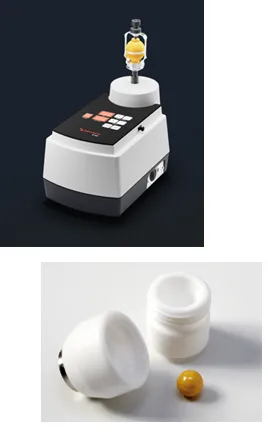
Mini-Mill PULVERISETTE 23
The PULVERISETTE 23 (P-23) is FRITSCH's ultra-compact Ball Mill for very small sample quantities. According to the current product page and the 2026 Product Profile, the sample quantity is approximately 0.1–15 mL depending on the material, the maximum feed size is about 6 mm, and final fineness can reach 5 μm. Dry, wet and cryogenic grinding are supported, with standard and Glovebox-ready versions available.
Key Features
• Spherical grinding bowls improve impact/friction efficiency and simplify sample recovery and cleaning.
• Regulated frequency: 15–50 Hz; bowl oscillations approximately 900–3,000/min at 9 mm amplitude.
• Sample quantity approximately 0.1–15 mL, suitable for very small samples and space-limited laboratories.
• Supports dry, wet and cryogenic grinding as well as mixing and homogenisation.
• Glovebox-ready version for oxygen-/moisture-free controlled atmospheres and isolated handling of hazardous, biohazardous, radioactive or pharmacologically active substances.
• PTFE bowls are available for biotechnology; a single-use tube container supports up to six 0.5 / 1.5 / 2 mL PCR tubes.
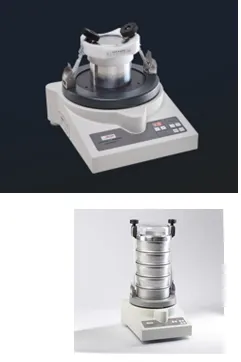
Vibratory Micro Mill PULVERISETTE 0
The PULVERISETTE 0 is designed for fine comminution of small quantities of medium-hard, brittle, moist and temperature-sensitive samples, and for homogenising emulsions and pastes. Maximum feed size is about 5 mm, maximum sample quantity 10 mL, and final fineness can reach 10 μm. Grinding is based on impact and friction, with cryogenic operation available using the FRITSCH cryo-box.
Key Features
• Adjustable oscillation amplitude for adapting vibration energy to the sample.
• Approximately 3,000–3,600 oscillations/min at 1–3 mm amplitude.
• Closed-vessel dry or suspension grinding to minimise sample loss.
• Cryo-box option for soft, slightly oily, fatty, moist or temperature-sensitive materials.
• Convertible to a vibratory sieve shaker for dry and wet sieving.
• The current website lists five grinding-set materials; steel or tungsten carbide is recommended for cryogenic grinding.
• IP65 splash-proof membrane keyboard, observation window and digital timer.
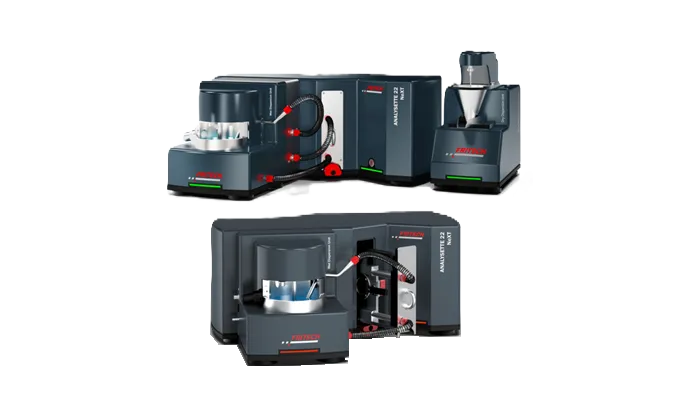
Laser Particle Sizer ANALYSETTE 22 NeXT
The FRITSCH Particle Size Analyzer utilizes the patented Reverse Fourier design. Our two ANALYSETTE 22 NeXT models are perfect for efficient particle size analysis in production, quality control, R&D, and for controlling manufacturing processes.
Choose the model that fits your needs and get all the key benefits: exceptionally easy operation and cleaning, short analysis times, reliably reproducible results, and the ability to record additional parameters like temperature and pH value during wet dispersion. If you're working with extremely aggressive chemical dispersion liquids, you can order the wet dispersion unit with the Extended conversion kit for extreme chemical resistance.
Key Features
- Strong Advantages During Measurement:
- Only one light source: simple, robust, reliable
- Quick and simultaneous recording of all scattering data
- Highly precise recording of light intensities with state-of-the-art 16-bit converter technology
- Records even very wide scattering angles due to intelligent measuring cell design
- Two models available with different measuring ranges
- Continuous logging of laser output
- Quick, automatic beam adjustment
- Strong Advantages During Dispersion:
- Simple operation
- Compact measuring circuit
- Powerful pump
- Practically maintenance-free design
- Monitoring of important dispersion parameters
- No dead space in the measuring and rinsing circulation system
- Fast and consistent cleaning
- Variable suspension volume between 150 ml and 500 ml
- Many organic solvents can also be used as a standard feature
- Separate ultrasonic box with up to 50 Watt output
- Freely programmable
- Dispersion bath without dead space
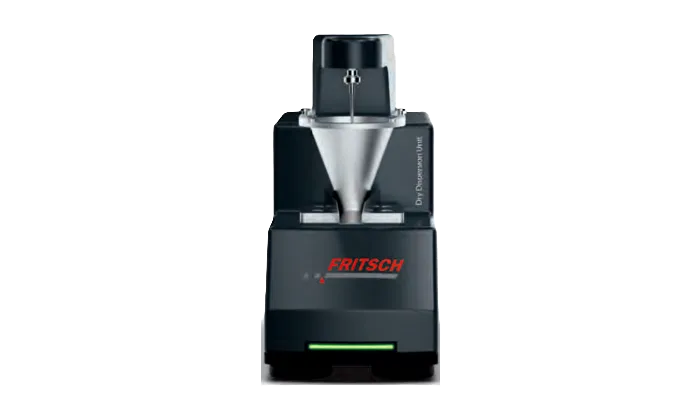
Laser Particle Sizer Dry Dispersion Unit
Its height-adjustable funnel and a stainless steel stirrer ensure optimal sample feeding, adaptable to the specific material.
Key Features
- All parts that contact the sample can be easily dismantled, ensuring quick and simple cleaning. The ANALYSETTE 22 NeXT's measuring cell can also be opened without tools via an eccentric lock. Cleaning is convenient with an easily re-insertable outer seal, and exchanging the measuring cell glass is always straightforward.
- For dry measurements, the sample material is transported by a vibratory feeder through the intake funnel into the dry measuring cell. There, it falls directly into a Venturi nozzle that operates with an adjustable compressed air flow. As the sample passes through the nozzle, agglomerates are broken up, and the particle size dispersion is measured immediately in the laser beam.
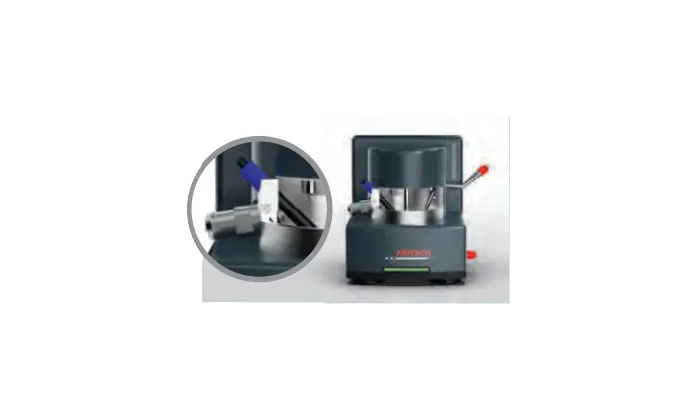
Laser Particle Sizer pH Measurement Module
The new pH sensor is installed as a module in the dispersion bath and connected to the Laser Particle Sizer, allowing for simple, continuous monitoring of the dispersion liquid's pH value.
Key Features
- The pH value is a crucial parameter for suspension stability. If it changes during measurement, particles may flocculate (coagulate), which often leads to irreproducible measurement results. FRITSCH's newly introduced pH measurement process enables precise observation of these values. It also makes detecting agglomeration or aggregation much easier.
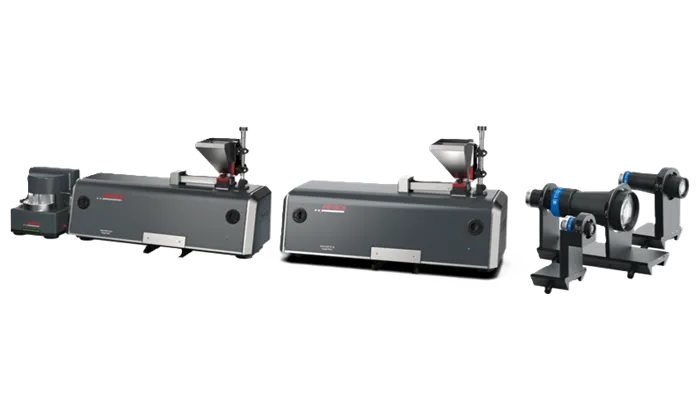
Laser Particle Sizer ANALYSETTE 28 ImageSizer
The ANALYSETTE 28 ImageSizer is the ideal particle sizer for all applications requiring accurate and reproducible measurement results for both the particle shape and size of powders, bulk solids, suspensions, and emulsions.
Its optical process of Dynamic Image Analysis provides results across a wide measuring range, delivers multiple shape parameters, and offers extensive evaluation possibilities for particle size. The measuring time, depending on sample quantity, is under 5 minutes, with immediate results. This makes it a very easy and cost-effective alternative to sieving.
Key Features
- Extra-wide measuring range, individually adjustable
- Variable measuring time – under 5 minutes
- High-performance camera with telecentric lenses
- Fast, simple operation via SOP control
- High-performance, integrated image analysis software ISS
- Extensive library for morphological analysis
- Useful tools for reliable quality monitoring
- Practical report generator for individual presentation of results