Skip to header

Main navigation

辛耘公司 SCIENTECH 辛耘企業股份有限公司
      • 認識我們
      • 核心價值
      • 組織架構
      • 經營團隊
      • 永續發展
      • 多元共融
      • 國際認證
      • 公共關係
      • 服務據點
      • 產品列表
      • 攝影鏡頭
      • 批次式晶圓濕製程設備
      • 單晶圓濕製程設備
      • 先進烘烤設備
      • 單片面板級解離層塗佈設備
      • 批次面板級濕製程設備
      • 單片面板級濕製程設備
      • 玻璃解離層塗佈設備
      • 暫時性貼合設備
      • 剝離清洗設備
      • 剝離設備
      • 12吋晶圓再生服務
      • 經營者的話
      • 永續委員會
      • 利害關係人
      • 重大性分析
      • 誠信務實
      • 溫馨職場
      • 環境友善
      • 回饋社會
      • 溫室氣體減量
      • 影像集錦
      • 永續報告書
      • 員工福利
      • 搜尋職缺
      • 學習成長
      • 公司概況
      • 營收報告
      • 財務報表
      • 董事會
      • 委員會
      • 內部稽核
      • 風險管理
      • 重要內規
      • 執行報告
      • 股東會
      • 法說會
      • 股價股利
      • 重大訊息
      • 聯絡我們
      • 最新消息
      • 活動展覽
      • 科儀新知
  • English
  • 繁體中文
辛耘企業股份有限公司

Advancing 3DIC Manufacturing with UBM Etching and Scientech's Customizable Solutions

Breadcrumb

  • Home
  • 科儀新知
  • Advancing 3DIC Manufacturing with UBM Etching and Scientech's Customizable Solutions

Three-dimensional integrated circuits (3DICs) have emerged as a promising solution to meet the increasing demands for high performance and compactness in modern applications. By stacking individual ICs/wafers together as a single package, 3DIC technology offers several advantages over traditional two-dimensional (2D) integrated circuits.

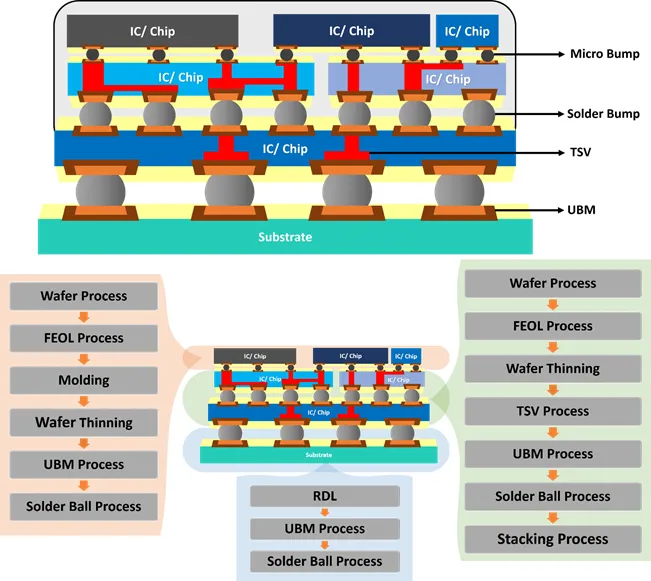
One of the key characteristics required for 3DICs is the reduction in wafer thickness. By stacking multiple layers vertically, the overall footprint of the circuit can be significantly reduced compared to a planar 2D layout. This enables higher circuit density and allows for more complex functionality within a smaller space. Another crucial requirement of 3DIC technology is the effective interconnect between the stacked ICs. Interconnects play a vital role in determining the performance of integrated circuits, as they enable communication between different components and layers. Interconnect technologies in 3DICs are Through-silicon vias (TSVs) and soldier bumps. TSVs are utilized to provide vertical connections within a stacked IC, solder bumps physically connect and communicate between the stacked ICs or chips.

A brief overview of the process flow for manufacturing 3DIC. Wafer Preparation: Involves cleaning, inspecting, and alignment. Front-end-of-Line (FEOL) Processing: the process involves the fabrication of active devices, such as transistors and logic circuits, on the base wafer. Wafer Thinning: The processed wafer is thinned to reduce the overall thickness through the wafer support system. TSV Formation: TSVs are vertical interconnects that pass through the silicon substrate. UBM Formation: UBM layer is formed on the surface of interconnects. The UBM layer provides a reliable electrical and mechanical connection between the chip and the solder bumps. A typical UBM layer consists of multiple metal layers, such as titanium (Ti), tungsten (W), and copper (Cu). Solder Bump Formation: Typically using techniques like solder reflow or solder ball placement, to create the solder bumps. These bumps will serve as the physical interconnections between the stacked ICs. Redistribution Layer (RDL): The primary function of the RDL is to connect with other devices, such as a printed circuit board (PCB) or another IC. Stacking: The thinned wafers are then stacked or bonded together, aligning the TSVs and the solder bumps on each layer. The stacked wafers are bonded using techniques such as fusion bonding or adhesive bonding. Packaging: Packaging processes involves encapsulating the 3DIC structure with protective materials, such as molding compounds or underfills, and connecting the external leads or pins to the solder bumps for electrical access. The overview of the process flow sequence is represented in Figure.

The implementation of solder balls in 3DICs can encounter significant drawbacks, including atom migration and intermetallic reactions that can lead to void formation and adversely impact electrical performance. To address these challenges, a viable strategy involves the deposition of barrier layers through under-bump metallization. This approach effectively mitigates the detrimental effects of atom migration and intermetallic reactions, resulting in enhanced reliability and performance of solder ball-based interconnects in 3DICs. The UBM process is important in 3DIC technology as it enables reliable electrical connections, enhances mechanical integrity, prevents intermetallic reactions, and controls bump shape and size. These factors collectively contribute to the performance, reliability, and manufacturability of 3DIC packages, facilitating the integration of multiple chips or dies in a compact and efficient manner.

Scientech plays a vital role in supporting a wide range of manufacturing processes in semiconductor technology, resulting in reduced thickness and enhanced performance. Specifically for 3DICs, Scientech offers various semiconductor process instruments, including temporary bonding and debonding, electro-plating, laser reflow ball mounting, wet etching, solder ball etching, and UBM etching. Among these tools, Scientech's UBM etching tool is highly popular in industries due to our expertise in customizing equipment to meet each client's unique needs with high precision. Additionally, the UBM etching tool is available in different modules, such as the single-wafer tool with only spray etching, and spray etching with immersion functionality which enhances the ability to etch the cavity below a micron. The ability to fine-tune processes for precise requirements has enabled the UBM etching tool to deliver high-quality work cost-effectively.

Furthermore, the tool's customization feasibility has led Scientech to play a vital role in supporting a wide range of manufacturing processes in semiconductor technology, resulting in reduced thickness and enhanced performance. Specifically for 3DICs, Scientech offers various semiconductor process instruments, including temporary bonding and debonding, electro-plating, laser reflow ball mounting, wet etching, solder ball etching, and UBM etching. Among these tools, Scientech's UBM etching tool is highly popular in industries due to our expertise in customizing equipment to meet each client's unique needs with high precision. Additionally, the UBM etching tool is available in different modules, such as the single-wafer tool with only spray etching, and spray etching with immersion functionality which enhances the ability to etch the cavity below a micron. The ability to fine-tune processes for precise requirements has enabled the UBM etching tool to deliver high-quality work cost-effectively.

To combine various processes, particularly integrating PR stripper, and metal liftoff with UBM etching. This combinational approach helps reduce manufacturing costs and processing time.

服務據點

廠區訊息

社群媒體

線上互動

聯絡我們

線上留言

關係企業

上海 | 美國 | 歐洲

入廠申請

訪客入口網站

承攬商管理

供應商入口網站

公司簡介
認識我們
核心價值
聯絡我們
產品服務
代理產品
自製設備
晶圓再生
永續發展
經營者的話
利害關係人
永續報告書
人才招募
學習成長
員工福利
搜尋職缺
投資人關係
營收報告
財務報表
法說會議
新聞中心
最新消息
活動展覽
科儀新知

Copyright ©SCIENTECH. 本網站所提及之公司名稱、產品、圖片與商標均屬原註冊公司所有。